
Gloucester Corrections Is Nonresidential
Gloucester County closed its residential jail on June 30, 2013. The Corrections Division at 70 Hunter Street remains active, but it is an administrative, classification, and transportation operation. Male and female offenders are not housed there. A person described as being in Gloucester custody may be physically held at Salem, Atlantic, Essex, another jail, or NJDOC depending on the custody sequence.
The office’s role is still substantial. Gloucester Classification handles legal custody, court appearances, facility assignments, time credits, transport, parole coordination, and lawful discharge for county prisoners. That administrative connection explains why Gloucester can hold useful records even when another county controls the cell, exit, property process, and physical movement log.
Gloucester Discharge Release Paths
All Gloucester arrestees are admitted first to Salem County Jail. After processing and classification, some may be transferred. A true community release normally occurs at the jail that actually holds the person. That facility records the physical date and time out, release type, and destination. Gloucester may record its discharge coordination, transport, time-credit decision, or the next placement.
A transfer remains custody. Movement from Salem to Atlantic or Essex calls for the receiving jail’s later exit record. Movement to NJDOC after a state sentence calls for the statewide offender search and state record. Delivery to a warrant-holding, federal, or immigration authority also continues custody until that next system documents its outcome. The Gloucester file helps route the search but does not turn each transfer into a release.
Confirm Gloucester Discharge Records
Begin with Gloucester Classification when the physical holder is unclear. Ask which facility admitted or last held the named person and what identifier links the placement to the Gloucester case. Then use New Jersey VINE for a current or recent event and request the physical movement record from the verified jail.
- Give Classification the full name, aliases, birth date if known, and Gloucester case or commitment number.
- Confirm the first Salem admission and any later transfer destination.
- Check New Jersey VINE and read the exact event rather than relying on name absence.
- Request the holding jail’s release, discharge, or transfer entry with the date, time, type, and destination.
- Request Gloucester’s classification, transport, time-credit, and discharge coordination records as needed.
- Compare the Gloucester court order or disposition and continue with any receiving authority.
The Gloucester County released-inmate guide covers the full county, state, court, federal, and immigration fallback chain. The correct source depends on the event being proved. Gloucester identifies and coordinates; the holding jail records the physical exit.
Gloucester Corrections Records Contact
Use the Corrections Division for placement questions and Gloucester-maintained classification, transport, time-credit, or discharge material. Telephone before visiting because no verified public-counter hours were published in the research. Formal county record requests use the Gloucester OPRA route rather than the Sheriff’s law-enforcement-only records mailbox.
Gloucester County Corrections Division
Gloucester County Sheriff’s Office
70 Hunter Street
Woodbury, NJ 08096
856-384-4607
Fax: 856-384-4613
gccorrections@co.gloucester.nj.us
For a formal request, Gloucester lists the County Custodian at 2 South Broad Street, 3rd Floor, Woodbury, NJ 08096, with telephone 856-853-3271 and fax 856-384-6894. The online OPRA form and printable form are the public channels. Court orders and case documents belong with NJ Courts, while a Salem-created movement or booking record belongs with Salem.
Request Gloucester Release Records
Describe an identifiable existing record. Ask for the Gloucester Corrections classification, transport, time-credit, discharge, or destination record for the named booking or commitment. Include the full name, aliases, birth date if known, booking, case, commitment, or SBI number, and the relevant date range. Request the recorded admission or placement, actual discharge coordination, movement type, and destination where maintained and disclosable.
| Office | Record role |
|---|---|
| Gloucester Corrections | Classification, transport, time credits, placement, and discharge coordination |
| Salem or partner jail | Physical booking, jail movement, release, transfer, and maintained image |
| NJ Courts | Release order, judgment, sentence, and case disposition |
| NJDOC | State-prison status, calculated dates, and Date Out-of-Custody |
Ordinary complete OPRA requests are generally due as soon as possible and within seven business days under the current guidance. Electronic access is generally free. Ordinary paper rates are five cents per letter page and seven cents per legal page, while actual supply or justified special-service costs may apply. An extension, redaction, or exemption can affect the result.
The Sheriff’s public records page draws a further routing line. Its Sheriff records email is reserved for law-enforcement agencies, so a member of the public should use the county OPRA form instead. The request can ask the custodian to identify the proper holder when Gloucester did not create the physical jail record. That is useful for a Salem admission because Gloucester may know the placement and transport facts while Salem keeps the booking and exit entry. Court documents still go to the Judiciary, not the county custodian.
A request for a booking image should name the precise booking and the office believed to maintain it. New Jersey’s record definition can include photographs, but disclosure is not automatic. Criminal-investigation and other exemptions may apply. The Corrections office should not be assumed to possess an image created by Salem or a partner jail. Ask for the existing image, accept lawful redaction or denial, and keep the image question separate from the movement record needed to prove discharge.
Gloucester Shared-Services Release Model
The former jail’s closure produced an active multi-county system rather than an empty Corrections function. A Gloucester resolution approved Salem custody services from June 1, 2024 through May 31, 2029. Current county pages also list Atlantic and Essex inquiry facilities. Salem remains the first admission point, while Classification may later change the holder. Facility pages and requests must reflect that live structure.
This is why a single Gloucester roster would be misleading. The case county, admitting jail, later holding jail, and state or federal receiving agency can all differ. Save each movement record and its identifier. A web result can change or disappear, while the created records remain subject to the relevant retention and access rules.
The official Gloucester Corrections page documents the current nonresidential role and contact route. The captured page below helps distinguish the working division from the closed residential jail.
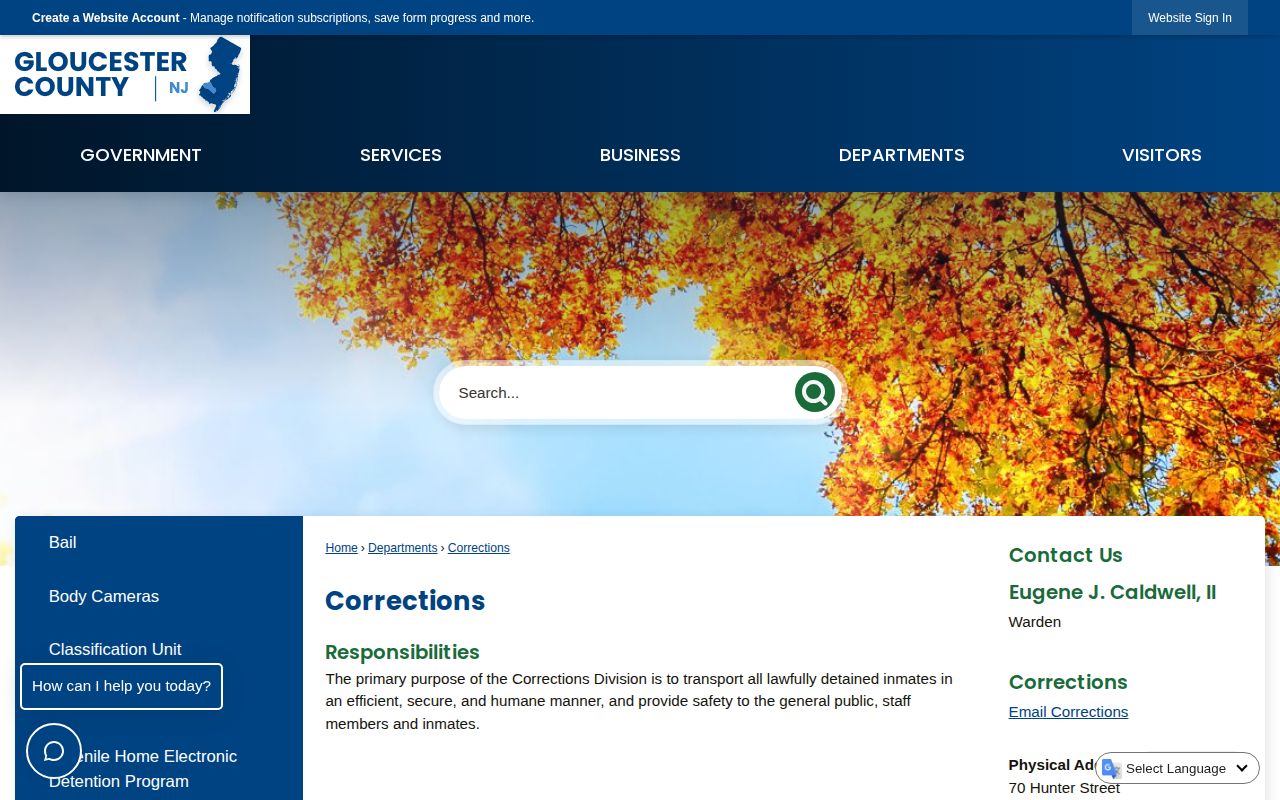
Use that office to locate the county’s part of the record, then contact the actual jail for the physical exit.
Gloucester Transport Is Not Release
The Transportation Unit operates around the clock throughout the year and reports more than 3,700 transports annually. That sourced figure describes secure custody movements. It does not count community releases and does not describe rides home. A transport can take a prisoner to court, a partner jail, NJDOC, or another lawful destination while custody continues.
Read the movement type before using the word release. A court trip, transfer, hospital movement, or delivery to another authority is not a community exit. Gloucester’s transport record may name the receiving office, while that receiving office later creates the next release or movement record.
Gloucester Bail Release Routing
Gloucester’s official bail guidance says payment is accepted at the facility where the inmate is housed. The Corrections office at 70 Hunter Street should not be assumed to accept bail for someone at Salem, Atlantic, Essex, or another jail. First identify the holder. Then confirm that facility’s current process.
A court release order and a jail movement record answer different questions. The order supplies legal authority. The holding jail documents the physical exit after holds and processing are resolved. No official countywide release-hour or pickup procedure was verified because the process belongs to the actual holder. Call that jail rather than promising when or where a person will emerge.
Gloucester Alternatives and Discharge
Gloucester operates court-ordered community alternatives, including a Labor Assistance Program and home electronic detention. Those programs are not jail release lists. They show that a person can remain under a structured court sanction without occupying a jail bed. Classification and court records are the proper sources for the legal status.
Probation is a Judiciary sentence and does not mean the same thing as parole. Parole generally follows state-prison custody and remains under the New Jersey State Parole Board. A Gloucester discharge record may point to the supervising authority, but it may not disclose the full supervision file. Verify the public court order or contact the responsible agency without seeking private reporting details.