
Projected and Actual Gloucester Releases
A projected date is a calculation based on the sentence, court-awarded credit, statutory credit, mandatory terms, and the person’s current record. It can move. An actual release date records a completed event. For a person in the New Jersey state system, the official forward-looking field is Current Max Release Date. After a state release, Date Out-of-Custody is the historical field to preserve while the public result remains available.
Current Parole Eligibility Date is separate. It is the latest expected eligibility benchmark under State Parole Board calculation policies, not a grant of parole. An eligible person may remain in custody after that date. Likewise, the Current Max Release Date does not prove that a person walked out. NJDOC says the calculation reflects days earned off the sentence and days added for negative institutional conduct, and it may differ at the end of each month.
Scheduled versus actual: A calculated or parole-eligibility date points forward. Date Out-of-Custody or the jail movement record confirms the completed release.
A pretrial Gloucester County detainee has no fixed sentence end to calculate. The release may depend on a pretrial decision, court order, dismissal, plea, detainer, or other case event. The actual jail entry is still needed because a court order and a physical exit answer different questions.
Find Gloucester County Release Dates
Choose the route by custody system. Gloucester County closed its residential jail, and its Classification Unit says every Gloucester arrestee is first admitted to Salem County Jail and may later be moved. A person serving only a county matter may never appear in NJDOC. Conversely, a person sentenced to state imprisonment leaves the county-jail path and enters the statewide corrections system.
- Identify whether the person is pretrial, serving a county sentence, or committed to NJDOC.
- For state imprisonment, open the NJDOC Offender Search and accept its terms.
- Match the person by the supported name or SBI-linked details, aliases, case information, and county of commitment.
- Read Current Max Release Date and Current Parole Eligibility Date separately. Do not present either as an actual exit.
- For a Gloucester county-jail matter, contact Classification and the actual holding jail, then inspect the controlling court order.
- After release, preserve Date Out-of-Custody for a state record or the release and movement entry for a county record.
“County of Commitment: Gloucester” identifies the venue tied to a state sentence. It does not mean the person is housed in Gloucester County. “Current Facility” names the state location. Keep the SBI number, sentence and case identifiers, dates in and out of custody, offense and sentence data, and exact calculated-date labels when distinguishing one record.
The broader Gloucester County release-record path helps when custody status, court data, and jail movements conflict.
Read Gloucester Release Date Fields
NJDOC’s labels describe different legal and administrative milestones. Reading them together avoids the common error of treating the earliest visible date as a promised release. The official NJDOC field help defines the fields and should control over a loose summary.
| Field | Meaning for a Gloucester record |
|---|---|
| Current Max Release Date | The most recent state calculation after earned days and days added for negative conduct. |
| Current Parole Eligibility Date | The latest expected eligibility benchmark under Board calculation policy, not a parole grant. |
| Date Out-of-Custody | The historical date the person left NJDOC custody. |
| Mandatory Minimum Term | The judge-imposed term before release is barred, minus applicable court-awarded credit. |
| Maximum Term | The total term under NJDOC or State Parole Board jurisdiction, subject to governing credits. |
| County of Commitment | The trial, conviction, and sentencing venue, not the physical prison. |
The NJDOC search form is the official doorway to those state fields. Its current interface should be read directly before relying on any filter or result layout.
The NJDOC offender-search screen separates state-prison records from the Salem and Gloucester county-record routes.
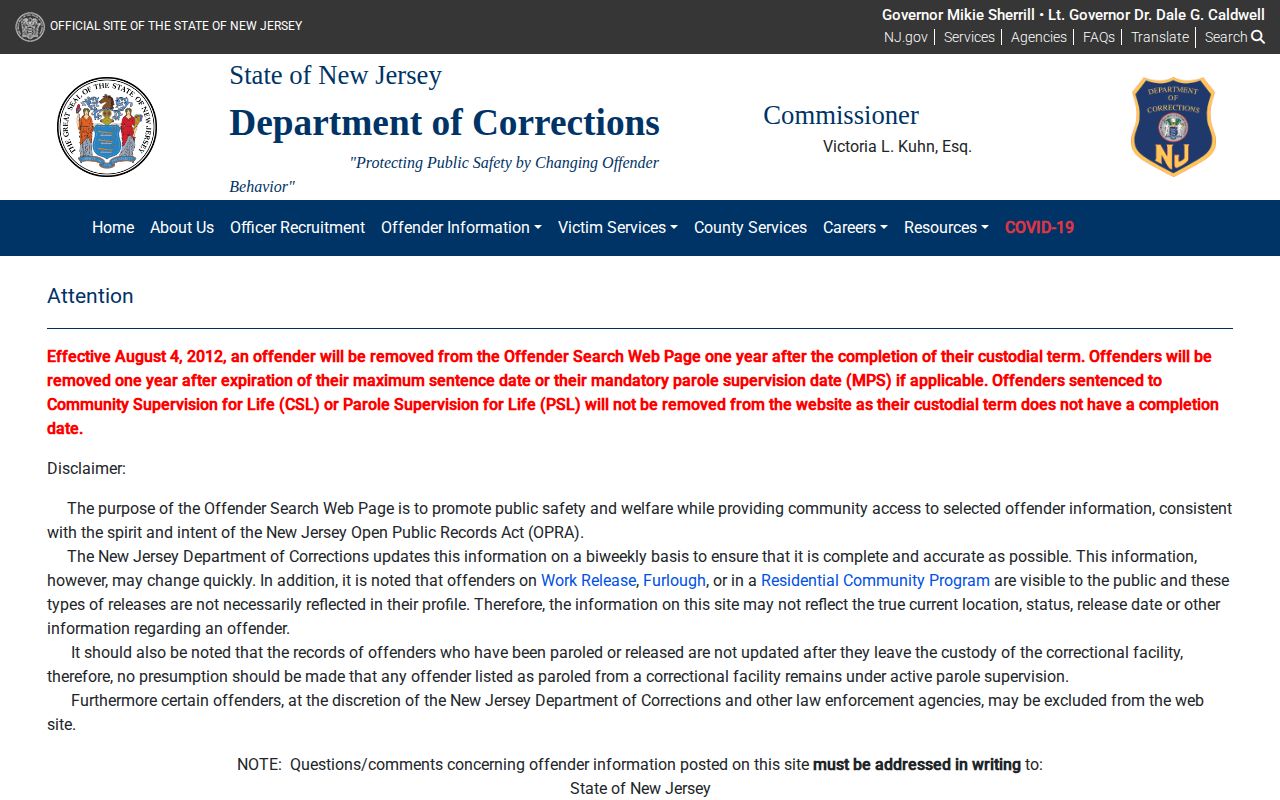
A candidate result must be matched to the intended person and Gloucester commitment. The search is not a roster of everyone booked at Salem County Correctional Facility.
Gloucester County Good-Time Credits
N.J.S.A. 30:4-140 provides a progressive commutation-credit schedule for continuous orderly conduct. Commutation credit is time that may reduce the maximum term under the governing statute and rules. It is not a promise of a specific date. Credit may be forfeited for misconduct, and restoration or recalculation can change the figure shown by NJDOC.
Official NJDOC rulemaking gives calculation examples. A three-year, six-month term can carry 252 days for its first three years plus six months at eight days each, for 300 potential days. An eight-year, two-month example totals 776 potential days. These examples explain how the schedule can work. They do not establish the credit or date for a named person because the sentence, mandatory minimum, court credits, conduct record, and governing rules must be applied to that record.
N.J.S.A. 30:4-92 authorizes institutional work credits. NJDOC rules determine when work, minimum, commutation, and other credits accrue. Ordinary commutation, work, and minimum credits reduce the maximum term but do not cut through a mandatory minimum. Court-awarded credit follows the sentence and court order.
- Commutation credit
- A statutory reduction tied to continuous orderly conduct, subject to limits and forfeiture.
- Work credit
- Credit authorized for qualifying institutional work under NJDOC law and rules.
- Mandatory minimum
- A period during which release is barred, apart from credit the governing law allows.
- Detainer
- A notice that another authority may claim custody, which can prevent a community release.
Note: County-jail work time must be confirmed with Gloucester Classification, the holding jail, and the court record rather than copied from a state example.
NERA and Gloucester Release Dates
New Jersey’s No Early Release Act, N.J.S.A. 2C:43-7.2, requires a person sentenced to imprisonment for an enumerated violent crime to serve 85% of the custodial term before parole eligibility. It is a truth-in-sentencing rule for the covered crimes. It is not a blanket rule for every New Jersey conviction, and it does not mean release occurs as soon as the percentage is reached.
Other court-imposed or statutory mandatory minimum terms can control. The general parole framework in N.J.S.A. 30:4-123.51 includes a one-third concept, but mandatory ineligibility terms and other provisions create exceptions. Parole eligibility starts a Board process. The State Parole Board may grant release for a future date and conditions, or deny parole and set a Future Eligibility Term.
For a Gloucester state-prison record, compare the conviction and sentence, mandatory-minimum field, Current Parole Eligibility Date, and Current Max Release Date. For a county-only sentence, do not apply the NJDOC calculator. Read the judgment and obtain the jail or Classification calculation that governs the actual custody.
Why Gloucester Release Dates Change
A calculated date is a live result of several records. One correction can affect the maximum term, while another event can change whether release will be into the community or into another authority’s custody. NJDOC’s month-end warning is central: the Current Max Release Date may differ when the next calculation is posted.
| Factor | Possible effect |
|---|---|
| Court correction or jail credit | Changes the term or the time already credited under the order. |
| Commutation or work credit | May reduce the maximum term when earned and lawfully applied. |
| Disciplinary forfeiture or restoration | Adds back or restores eligible days in the state calculation. |
| Mandatory minimum | Blocks release before the controlling term ends. |
| Parole action | A grant can set a future release date; a denial can set a new eligibility term. |
| New sentence, warrant, or detainer | Can extend custody or transfer the person to another authority. |
| Routine recalculation | Can move the current projection as NJDOC updates the record. |
A court release order may remove one legal basis for detention while a separate hold remains. Likewise, a person can leave NJDOC and enter another agency’s custody. The movement is real, but it is not yet a release into the community.
Gloucester County Time-Credit Routing
Gloucester’s shared-services system creates a distinctive calculation path. The county’s Classification Unit expressly manages inmate time credits and lawful discharge even though the person is held at Salem or another partner jail. The holding facility records the physical custody movement. Gloucester maintains classification, court, transport, and related discharge functions. A sound county-date check may therefore require both offices.
Ask Gloucester Classification which calculation or court document controls the date. Ask the verified holding jail for the custody entry, date and time out, movement type, and destination. If the person was transferred, continue with the receiving agency. The former Gloucester County Jail at 70 Hunter Street is not an operating residential jail, so a date issued or coordinated there should not be described as a physical release from that building.
The NJDOC field guide shows why the state route stays distinct from this county process.
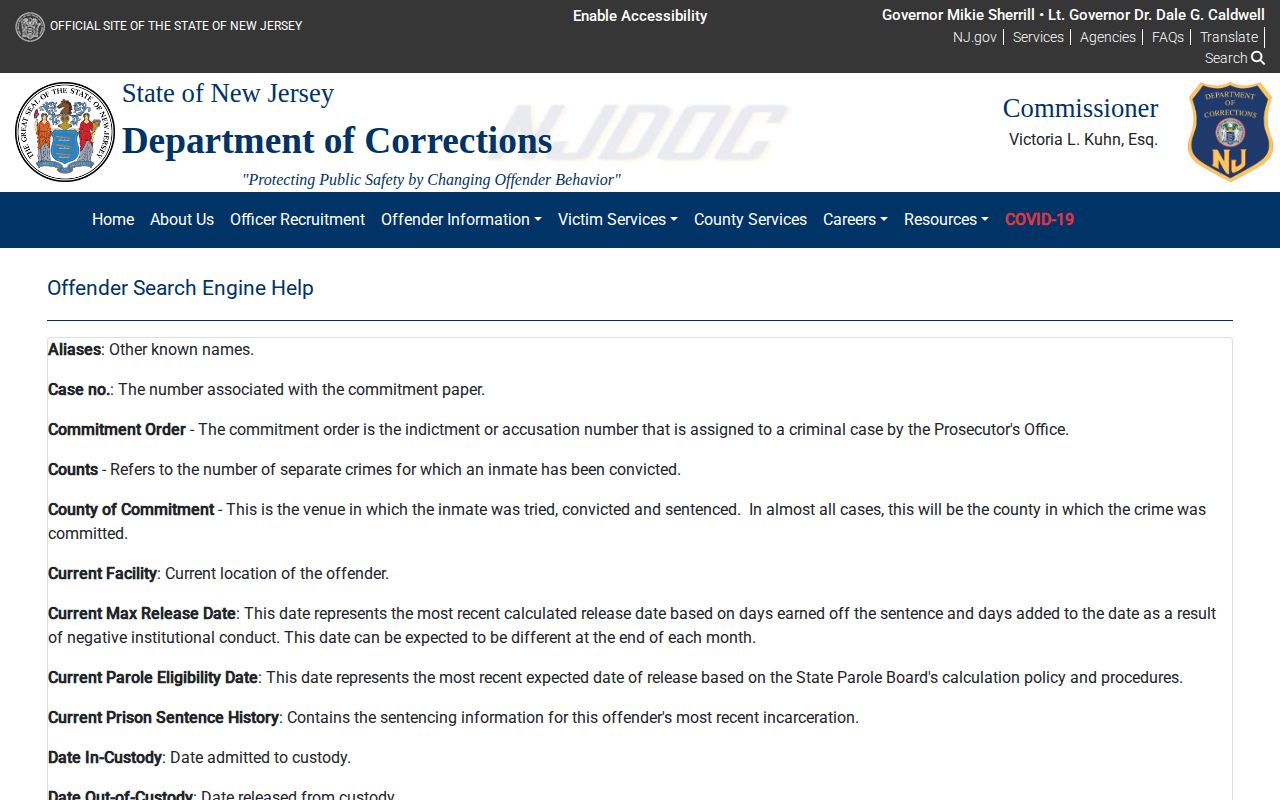
Its exact state labels clarify what changes monthly and what later confirms a completed state release. County time credit still comes from the county and holding-jail record path.
Confirm Gloucester County Release Dates
For a state prisoner, save the relevant calculated fields, then return after the event and look for Date Out-of-Custody. A retained NJDOC result can corroborate the state release, sentence history, and Gloucester county of commitment. Most completed state records are removed from the web search one year after completion of the custodial term, maximum-sentence endpoint, or mandatory-parole-supervision endpoint, subject to NJDOC’s stated exceptions. A formal NJDOC record request or court record may be needed later.
For a county-jail episode, request the affirmative release or movement entry. The person’s absence from a live custody result is weak evidence because it can mean transfer, a mismatch, or an update delay. For a pending custody change, a Gloucester County VINE check can send an alert, but the jail or NJDOC source should confirm the actual event.
Call Salem County Correctional Facility at 856-769-4300 for current routing when Salem is the holder. If Classification identifies Atlantic or Essex, contact that facility. Preserve the exact date label and the agency that issued it. A projection answers when release may occur. The later custody record answers when it did.