
Gloucester County Supervision Paths
Parole and probation can both keep a person under legal supervision in the community, but they begin in different ways. New Jersey parole is administered by the New Jersey State Parole Board. It generally follows release from a state-prison sentence while Board jurisdiction continues. Probation is a sentence imposed by a court and administered by the New Jersey Judiciary. It may follow a Gloucester county-jail matter or may be imposed without a state-prison term.
| Point | Parole | Probation |
|---|---|---|
| Legal source | Conditional release tied to a state-prison sentence | Court sentence allowing supervision in the community |
| Responsible agency | New Jersey State Parole Board | New Jersey Judiciary |
| Useful public record | Board record, NJDOC record, or parole eligibility notice | Judgment, sentencing order, or disposition |
| Local route | District Office 10 | Vicinage 15 Gloucester Probation |
| Public lookup limit | No complete public parolee database was found | No official public probationer lookup was found |
A county jail release entry may name a supervising authority, but it does not replace the agency record. It also does not prove that supervision is still active. Match the person’s identifiers and case route before drawing a conclusion.
- Parole
- Conditional release from a state sentence while State Parole Board authority continues.
- Probation
- A court sentence carried out under Judiciary supervision in the community.
- Absconder
- A person alleged to have stopped complying with supervision or stopped reporting, subject to official confirmation.
- Discharge
- The formal end of the agency’s supervision authority under the applicable sentence or order.
Verify Gloucester County Post-Release Supervision
Start with the sentence, not a current jail roster. A person who has left Salem County Correctional Facility may have been released before trial, placed on probation, paroled after a state sentence, or released without either form of supervision. Gloucester’s jail movement record establishes the physical exit. The court and State Parole Board establish the supervision path.
- Identify the Gloucester case and determine whether the record shows a state-prison sentence, probation sentence, or another disposition.
- For a state-prison case, compare the NJDOC result and SBI number, then use the State Parole Board offender-information route for official person-specific information.
- For probation, obtain the public judgment, sentencing order, or disposition through New Jersey Courts. Do not treat a private probation file as a public lookup.
- Contact the correct office with the person’s full name, SBI or case identifier when known, and a focused request for releasable official information.
- Record the source and date checked. A prior parole eligibility date, old warrant listing, or jail release does not prove current supervision.
The Board directs specific parole inquiries to its Public Information Office and supplies an OPRA form for formal records. Court Rule 1:38-3 and Judiciary request material restrict important parts of probation and pretrial-service files. Public verification should stay within the judgment, docket, and releasable agency response.
A Gloucester County post-release supervision check should also preserve the difference between eligibility, active supervision, and discharge. Gloucester County court records can establish probation at sentencing. Gloucester County commitment information can lead to the Board route. Neither record alone proves that supervision remains active on the day of the inquiry.
Note: Never publish or infer a person’s reporting schedule, residence, or other confidential supervision details.
Gloucester County Supervision Offices
Gloucester parole and probation use different regional offices. The State Parole Board’s FY2024 annual report identifies District Office 10 as serving Cumberland, Gloucester, and Salem Counties. Its location is in Bridgeton, outside Gloucester County. Gloucester Probation is in Woodbury at the Justice Complex within Vicinage 15. The shared regional structure explains why a Gloucester case can require contact with an office in another county.
State Parole Board District Office 10
Bridgeton State Office Building
40 East Broad Street, Suite 101
Bridgeton, NJ 08302-2847
Phone: 856-575-5588
Gloucester Probation, Vicinage 15
Gloucester County Justice Complex
70 Hunter Street
Woodbury, NJ
General line: 856-878-5050
The Woodbury address is also associated with the former county jail and current Corrections Division. It is not a current residential jail. State the office name when seeking probation help so the address is not mistaken for a custody location. No verified public-counter hours were provided for either office, so call first for current instructions.
Gloucester County parole questions belong with District Office 10 or the Board’s central public-information route. Gloucester County probation questions belong with Vicinage 15. Keeping those routes separate prevents a court sentence from being mislabeled as parole and a state release from being mislabeled as probation.
Gloucester County Parole Hearing Records
The State Parole Board uses an initial hearing through a Division of Release hearing officer, followed by a two-member panel hearing. The panel may grant parole and set a future date and conditions, or deny parole and establish a Future Eligibility Term. A rescission hearing can address new adverse information before a planned release. A revocation proceeding concerns conduct after parole has begun and can end in revocation or continued supervision with conditions.
The Gloucester Parole Eligibility Notice is a public weekly notice organized by county of commitment. It includes identifiers, location, offense and indictment details, sentence information, and notes. It may carry status notes such as released, revoked, or returned to custody, but it is not a complete hearing calendar or a person-by-person decisions database.
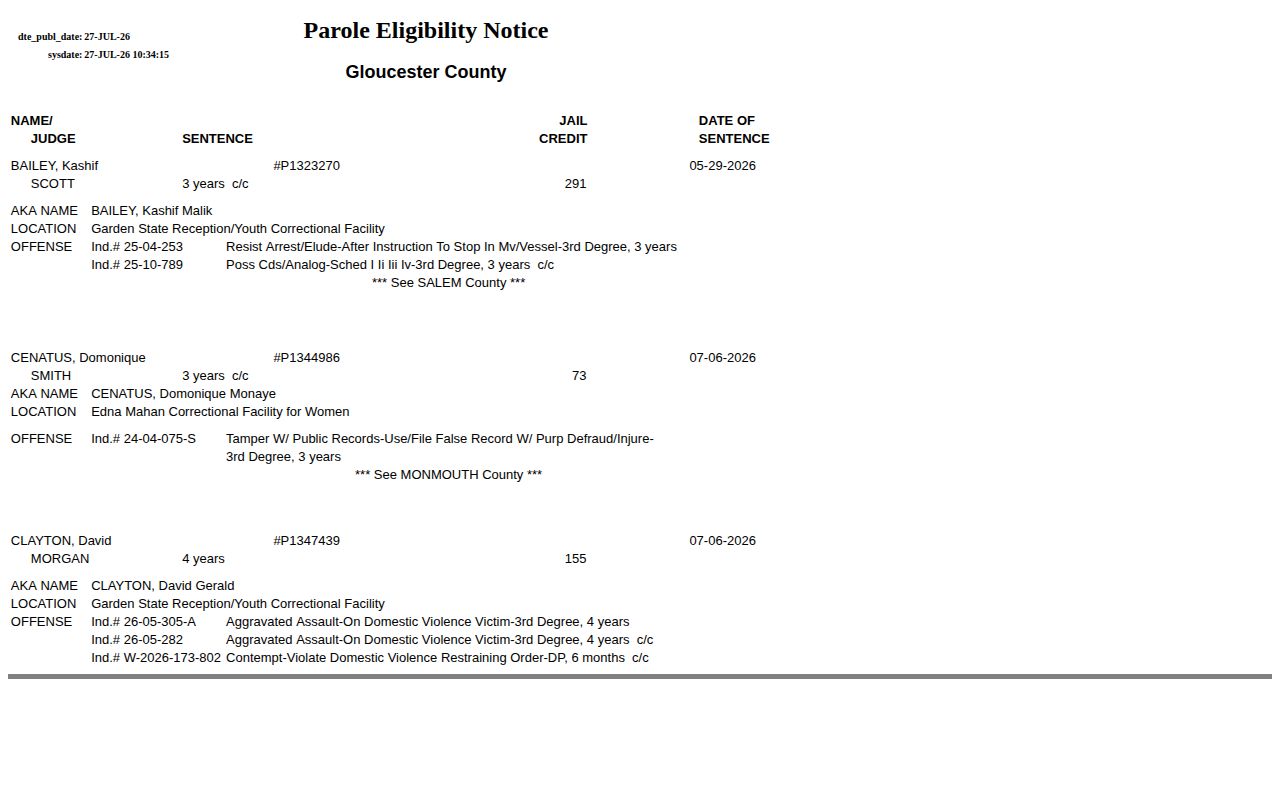
The captured notice shows the official Gloucester route. It must be read as an eligibility publication, not a promise that parole was granted. Full-board meeting agendas and minutes concern Board governance and are not individual hearing results.
New Jersey’s general eligibility framework uses a one-third concept under N.J.S.A. 30:4-123.51 unless a mandatory minimum, parole-ineligibility term, or another rule controls. Eligibility still does not establish release. Request the specific Board record when the decision itself matters.
Gloucester County Warrants and Absconders
The Gloucester County Warrants Unit says it handles probation-violation and state-parole warrants among its duties. A warrant can show that an agency seeks a person, but it does not give the original release date. It also does not prove the person is currently outside custody. An arrest or return may have occurred after the public information was posted.
Gloucester County’s Most Wanted page is selective. It is not a complete list of parole absconders, probation violations, or all active warrants. Likewise, the State Parole Board does not provide a complete public absconder search. Check a named person through the responsible agency rather than treating omission from a public list as a cleared status.
A parole violation can lead to arrest, a return to NJDOC’s Central Reception and Assignment Facility, preliminary and revocation proceedings, revocation with a new eligibility term, or continuation on parole. VINE may report a custody or DOC parole event in a participating record. That notification is a prompt to verify the event, not a complete supervision history.
Note: Wanted and warrant pages can change quickly and cannot establish whether Gloucester County supervision has ended.
Gloucester County Reentry Navigation
Regional support does not verify legal status. The Volunteers of America Safe Return listing serves Gloucester, Salem, Cumberland, and Camden residents recently released without supervision. Gloucester Probation has also hosted a public resource event with case-management, treatment, and social-service providers. These sources can help a person navigate services, but they do not prove parole, probation, discharge, or custody.
The distinction is useful in Gloucester County because the correctional and supervision routes are regional. A person may leave a partner jail, report to a Board office in Bridgeton, use court services in Woodbury, or seek regional support elsewhere. Keep service navigation separate from the formal agency record. Only the court or State Parole Board can confirm the legal supervision path within its authority.
Gloucester County service participation is not a supervision status. Gloucester County residents without supervision may use regional support, while a supervised person may use other services. The service provider should never be treated as the official source of a parole, probation, warrant, or discharge record.
Gloucester County Supervision Changes
Conditions come from the controlling order or agency decision. Public records may show that conditions exist, yet confidential reporting details should not be requested or repeated without a lawful basis. A violation allegation is not the same as a final finding. The official proceeding determines whether supervision continues, changes, or is revoked.
VINE distinguishes release, transfer, escape, return from escape, unsupervised custody, court movement, DOC parole actions, and death. These events do not all mean the same thing. For example, leaving a county jail for municipal court is a court movement and only a possible later release. A transfer back into NJDOC custody can follow a parole issue without ending the underlying sentence.
For a broad identity and custody check before the supervision question is reached, use the Gloucester County released-inmate search path. It separates county jail, state prison, court, federal, and immigration records. Once parole or probation is supported, return to the responsible Board or Judiciary record.
Ending Gloucester County Supervision
Release from jail and discharge from supervision are separate events. A person can leave custody yet remain on parole until State Parole Board authority ends. A person sentenced to probation remains under the court order until the Judiciary records completion, termination, or another lawful outcome. The original jail release date does not establish either discharge.
For Gloucester County parole, seek a Board record or official response showing the current status or discharge. NJDOC sentence fields and Date Out-of-Custody can provide context, but they do not replace the Board’s supervision record. For probation, use the public court case and request an identified order or judgment. Confidential probation records may remain restricted even when the supervision term has ended.
Keep the final record with the identifiers used to match the person. “Discharge” means the formal end of the relevant supervision authority, not merely that a name disappeared from a page. Expungement is a separate court process that changes public access to covered case records. It should not be described as a routine form of supervision discharge.
Note: Confirm the ending event with the agency that supervised the person, not with a former holding jail.